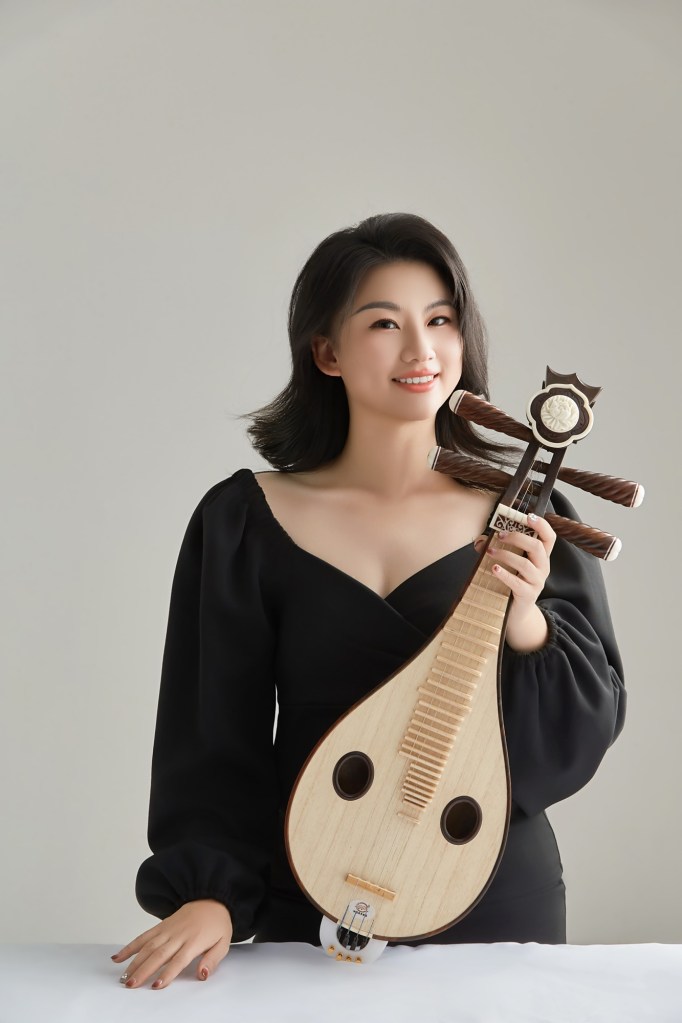
The liuqin(柳琴), known as the “Eastern Mandolin“,also known as the willow-leaf lute, small pipa, or golden leg, is a high-pitched plucked string instrument from China. It has a bright and clear tone and is commonly found in Jiangsu, Shandong, and Anhui provinces.
The liuqin resembles the pipa in shape but is more “compact, short, and rounded” in appearance. It evolved from the ordinary pipa during the Tang Dynasty, initially gaining popularity in Shandong. By the Song Dynasty, it spread to Jiangsu, which became a primary production area. During the Ming Dynasty, it further spread to Anhui, and to this day, the people in these three provinces and their bordering areas are the main users of the liuqin. Originally, the liuqin was confined to these regions, but its clear and powerful high notes contributed to its widespread popularity during the Qing Dynasty when opera flourished, reaching its peak.
Although the liuqin existed since the Tang Dynasty, its specific definition and the name “liuqin” were fully established only in the late Qing Dynasty. Before that, it was considered a modified version of the pipa, which led to its role as a primary accompaniment for liuqin opera, Sizhou opera, and luantan, as well as in Changzhou silk-string performances. There are several theories regarding its origin:
- In the 1860s, performers of La Huan Qiang in the Lunan area made the liuqin by hollowing out willow trees, imitating the pipa and yueqin.
- A scholar named Su from Su Lou Village in Tengxian collaborated with local artists and carpenters to develop it.
- La Huan Qiang performers Wu Da and Wu Er from Linyi created a two-string earthen pipa for singing and begging, inspired by the pipa held by the Guotian King.
The earliest liuqin had a simple structure with only two silk strings and a narrow range of just one and a half octaves. In 1958, musician Wang Huiran established a unified definition for the liuqin, classifying it into high-pitched versions with 3 or 4 strings, expanding its notes to 24 and 29, arranged according to equal temperament, and it began to be played with a plectrum.
In the 1970s, the second generation of the liuqin emerged, featuring a four-string high-pitched version. This new version increased the number of strings and sound posts, and most notably, bamboo replaced sorghum stalks, while steel wire replaced silk strings. These reforms significantly improved the performance characteristics of the liuqin, enriching its expressive capability. This marked the transition of the liuqin from being merely an accompanying instrument for over 200 years to developing into a solo instrument.
After the 1980s, due to its beautiful high-pitched tones, original solo pieces and concertos began to be composed specifically for the liuqin. In national orchestras, the liuqin, with its strong penetrating sound, is often used to perform main melodies in the high register and can also play elaborate and technically demanding passages. It is suitable for both lively, contrasting, rhythmic, and energetic tunes, as well as for beautiful, lyrical melodies.

 SALLY XI